
Knob and Tube Wiring in Ottawa: Insurance Risks, Safety Concerns & What a Home Rewire Actually Costs
Quick Answer — Knob & Tube Wiring
Knob and tube wiring is the original electrical wiring found in Ottawa homes built before 1950. It’s not illegal to have, but it IS a serious insurance, safety, and resale liability. Most Ontario insurers won’t cover homes with active knob and tube — or charge steep premiums. A full home rewire to replace knob and tube costs $8,000–$20,000+ depending on home size and accessibility. The cost to rewire a house is one of the best investments in an older Ottawa home: it eliminates fire risk, restores full insurance coverage, and opens the door to modern electrical capacity.
🏠 Free knob & tube assessment: (613) 518-5010
If you own an older Ottawa home — particularly in Centretown, The Glebe, Sandy Hill, Old Ottawa South, or Hintonburg — there’s a real chance your walls still contain knob and tube wiring. This electrical system was standard from the 1880s through the 1940s, and while it was innovative for its time, it was never designed for the electrical loads of modern life: air conditioning, EV chargers, home offices, and kitchens full of high-draw appliances.
The bigger problem? Most Ontario insurance companies won’t insure homes with active knob and tube wiring — or will only cover you at significantly higher premiums with exclusions. If you’re buying, selling, or renovating an older Ottawa home, understanding the cost to rewire a house and the urgency of replacement is critical. This guide from Ottawa Electric Service explains everything.
What Is Knob and Tube Wiring? How to Identify It in Your Ottawa Home
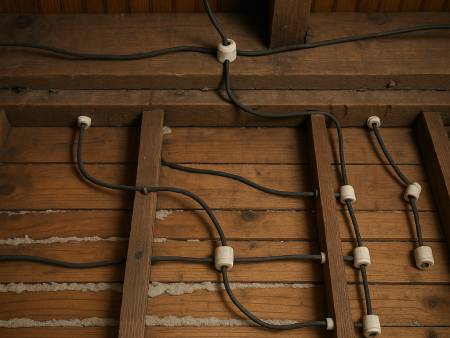
Knob and tube wiring (K&T) is an early electrical wiring method that uses individual copper conductors run through ceramic “knobs” (for support) and ceramic “tubes” (to pass through joists and studs). Unlike modern Romex cable that bundles hot, neutral, and ground wires together in a single sheath, K&T runs each wire separately with air space between them for cooling.
🔍 How to Identify Knob and Tube
- White ceramic knobs nailed to joists in your attic or basement
- Ceramic tubes passing through framing members
- Two separate wires (not bundled) with cloth/rubber insulation
- No ground wire (only two conductors — hot and neutral)
- Fabric-wrapped wires that may be brittle or crumbling
- Round, black, two-prong outlets throughout the home
📍 Ottawa Neighbourhoods Most Affected
- Centretown — 1890s–1940s rowhouses and duplexes
- The Glebe — 1900s–1930s single-family homes
- Sandy Hill — 1880s–1920s heritage properties
- Old Ottawa South — 1920s–1940s residential
- Hintonburg / Westboro — pre-war homes mixed with newer
- Lower Town / Vanier — early 1900s construction
⚠️ The Insulation Danger
Knob and tube wiring was designed to dissipate heat through air circulation. When blown-in insulation is added over K&T wiring (common during Ottawa energy retrofits), the wires can’t cool — creating a fire hazard. If your home had insulation blown into the attic or walls and still has K&T wiring, this is an urgent safety concern that requires immediate electrical inspection.
5 Reasons Knob and Tube Wiring Is a Problem in 2026
K&T wiring isn’t automatically dangerous just because it’s old — but after 80–140 years, the risks are real and compounding:
No Ground Wire = No Protection
K&T has only two conductors — no ground. This means no protection against short circuits or ground faults. Modern appliances, computers, and electronics require grounded circuits. Without grounding, shock and fire risks increase significantly. This is the same issue covered in our residential wiring service guide.
Degraded Insulation = Fire Risk
The original cloth and rubber insulation on K&T wires becomes brittle and crumbles after decades, exposing bare copper. Exposed wire touching wood framing, other wires, or insulation creates direct fire and shock hazards.
Inadequate Capacity for Modern Life
K&T circuits were designed for lights and a radio — typically 15 amps total. Today’s homes need 200 amps to run air conditioning, EV chargers, electric ranges, dryers, home offices, and more. Overloading K&T circuits causes overheating — the insulation can’t handle the heat, and there are no breakers to protect it.
DIY Modifications Make It Worse
Over decades, homeowners and unlicensed handymen splice into K&T wiring, add extension circuits, use improper connections (tape instead of junction boxes), and mix K&T with modern wiring incorrectly. These modifications are the #1 cause of K&T-related electrical fires.
Insurance Refusal = Major Financial Exposure
If your insurer discovers active K&T wiring and drops your coverage — or refuses to pay a claim because of it — you’re personally liable for any fire, water, or injury damages. This can be financially devastating. A home rewire is a fraction of the cost of an uninsured loss.
The Insurance Problem: How Knob and Tube Affects Your Coverage
This is often the trigger that finally motivates homeowners to invest in a home rewire. Here’s the reality in Ontario:
💡 Keep Your ESA Certificate
After a home rewire, your electrician files an ESA notification and the Electrical Safety Authority inspects the work. The resulting ESA certificate is your proof of compliant wiring. Keep this document permanently — your insurer will request it, and it’s invaluable when selling the home.
Cost to Rewire a House in Ottawa: Full Price Guide
The cost to rewire a house varies significantly based on home size, accessibility, and scope. Here’s what Ottawa homeowners can expect:
What Affects the Cost to Rewire a House
Wall Type & Access
Plaster-and-lath walls (common in K&T era homes) are harder to fish wire through than drywall. Attic and basement access significantly reduces cost. Limited access means more wall openings and patching.
Number of Circuits Needed
A K&T home might have 4–6 circuits. A modern home rewire typically installs 20–30+ circuits to meet today’s code and demand. More circuits = more wire, more breakers, more labour.
Panel Upgrade
K&T homes often have 60A fuse boxes. A 200A panel upgrade is included in most full rewires ($2,500–$4,500 of the total), giving you modern capacity for all current and future loads.
Heritage Considerations
In designated heritage homes, exterior changes and some interior work require approval. Experienced electricians know how to route wiring with minimal impact on original finishes and plasterwork.
Knob & Tube? Let’s Get You a Rewire Quote.
Free on-site assessment. Transparent all-in pricing. ESA certified.
What Happens During a Home Rewire: The Process Explained
A full home rewire is one of the most involved residential wiring service projects an electrician performs. Here’s the step-by-step process:
Assessment & Plan
Full electrical inspection, map existing wiring, design new circuit layout, calculate load, and provide detailed quote.
New Panel & Service
Install new 200A panel, coordinate with Hydro Ottawa for service entrance upgrade, obtain all ESA permits.
Wire Pulling
Run new Romex (NMD90) cable throughout the home via attic, basement, and wall cavities. Install new grounded outlets, switches, and junction boxes. Takes 3–7 days depending on home size.
Testing & Inspection
Test every circuit, verify grounding, confirm arc-fault protection (code requirement), schedule ESA inspection, and provide certificate. Patch wall openings.
The Best Time to Rewire: During a Renovation
If you’re planning a renovation on an older Ottawa home, that’s the ideal time to tackle the home rewire. When walls, ceilings, or floors are already opened for kitchen, bathroom, or basement work, the electrician can run new wiring with zero additional drywall damage. This reduces the cost to rewire a house by 30–50% compared to rewiring through closed walls. Even if you’re only renovating one floor, doing the rewire for the entire house at the same time saves on mobilization costs and ensures consistent, code-compliant wiring throughout.
Knob and Tube vs. Aluminum Wiring: Ottawa’s Two Old-Wiring Problems
Ottawa has two generations of problematic wiring. Understanding which you have determines the right solution:
🔌 Knob and Tube (Pre-1950)
- Separate conductors, ceramic supports
- No ground wire at all
- Cloth/rubber insulation (degrades)
- Solution: Full home rewire required
- Cost: $8,000–$30,000+
⚡ Aluminum Wiring (1965–1976)
- Single conductor in Romex-style cable
- Has ground wire
- Connection oxidation is the risk
- Solution: Copalum crimp or full rewire
- Cost: $3,000–$6,000 (remediation) or $10K+ (rewire)
Why Ottawa Homeowners Trust Ottawa Electric Service for Rewiring
Rewiring a home — especially one with knob and tube wiring — requires experience with older construction. Our licensed electricians specialize in Ottawa’s older homes:
- Heritage home specialists — we rewire century homes in Centretown, The Glebe, and Sandy Hill with minimal wall damage
- Transparent all-in pricing — panel, wiring, outlets, switches, ESA permits, and inspection all included
- Insurance coordination — we provide the documentation your insurer needs to restore standard coverage
- Future-proofing — we wire for modern needs including EV charger circuits, smart lighting, and home office dedicated circuits
- Bundle savings — combine your rewire with a renovation, surge protection, and smoke/CO detector upgrades for maximum value
For Ontario electrical safety requirements, visit the Electrical Safety Authority. For federal home energy incentives that may offset upgrade costs, see Natural Resources Canada.
Home Rewiring Service Areas
Frequently Asked Questions: Knob and Tube Wiring
Is knob and tube wiring illegal in Ontario?
No — it’s not illegal to have knob and tube wiring in your home. The Ontario Electrical Safety Code doesn’t require its removal. However, it IS illegal to extend, modify, or add to existing K&T wiring. In practice, insurance availability is the real enforcement mechanism — without insurance, you can’t carry a mortgage, and selling becomes extremely difficult.
How much does it cost to rewire a house in Ottawa?
A full home rewire in Ottawa costs $8,000–$30,000+ depending on home size and complexity. A typical 1,500–2,500 sq ft Centretown or Glebe home runs $14,000–$22,000 including a 200A panel upgrade, all new wiring, grounded outlets, and ESA permit/inspection. A partial rewire of critical circuits (kitchen, bathroom, panel) can run $3,000–$8,000.
Will my insurance be cancelled if I have knob and tube wiring?
Many Ontario insurers will not write new policies for homes with active knob and tube wiring, and some will cancel or refuse to renew existing policies once K&T is discovered (often during a renovation or claim). Some specialty insurers will cover K&T homes at significantly higher premiums with exclusions. A complete home rewire with ESA certificate restores you to standard rates.
Can I do a partial rewire instead of replacing everything?
Sometimes yes. If K&T is limited to certain areas (attic only, for example) or if budget is a constraint, a partial rewire of high-risk circuits (kitchen, bathroom, laundry, panel) can be done for $3,000–$8,000. This may satisfy some insurers temporarily. However, a full rewire is the permanent solution and is always our recommendation for long-term safety and home value.
How long does a home rewire take?
A full rewire of a typical Ottawa home takes 3–7 working days for the electrical work. Small bungalows can be done in 3–4 days, while larger multi-storey homes may need 5–7 days. Add 1–2 days for panel upgrade and service entrance work. Wall patching and painting (if needed) is separate. Power is maintained throughout most of the process, with brief shutdowns during panel work.
Will the walls need to be opened during a rewire?
Some wall openings are typically necessary, but experienced electricians minimize this by using existing access paths (attic, basement, existing outlet boxes) and specialized fishing tools. The goal is to route wire through wall cavities without large-scale demolition. Small access holes (easily patched) are common. Rewiring during a renovation when walls are already open is the most cost-effective approach.
How do I know if my Ottawa home has knob and tube wiring?
Look in your attic, basement, or any area where wiring is visible. K&T is identified by white ceramic knobs attached to joists, ceramic tubes passing through framing, and two separate wires (not bundled) with cloth or rubber insulation. Two-prong outlets throughout the home are another indicator. If you’re unsure, a licensed electrician can confirm during a quick inspection.
Can I add insulation to my attic if I have knob and tube wiring?
It is strongly discouraged and potentially dangerous. K&T was designed to dissipate heat through air circulation. Covering it with insulation (blown-in or batts) traps heat and creates a fire hazard. Many insulation contractors will refuse to insulate over K&T. The recommended approach: rewire the attic first, then insulate — you’ll improve both safety and energy efficiency.
Should I rewire before selling my Ottawa home?
Almost always yes. K&T wiring scares buyers because of insurance complications and the perceived (and real) safety risk. It typically reduces offers by $15,000–$30,000 or more — often more than the cost of the rewire itself. A pre-sale rewire with ESA certificate eliminates the buyer’s objection, opens up insurance options, and makes the home mortgage-eligible for all buyers.
Is it worth buying a home with knob and tube wiring?
It can be — if you factor the cost to rewire a house into your offer. Many beautiful Ottawa heritage homes in desirable neighbourhoods still have K&T. Budget $10,000–$25,000 for a full rewire (get an electrician’s quote before closing) and negotiate the purchase price accordingly. The key is to account for the rewire cost upfront rather than being surprised after closing.
Knob & Tube? Get a Rewire Quote Today.
Heritage home specialists. All-in pricing. ESA certified. Insurance-ready documentation.
Serving Centretown, The Glebe, Sandy Hill, Old Ottawa South, Hintonburg & all of Ottawa.